Installation

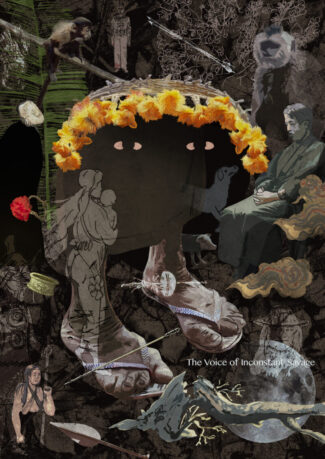
The Voice of Inconstant Savage
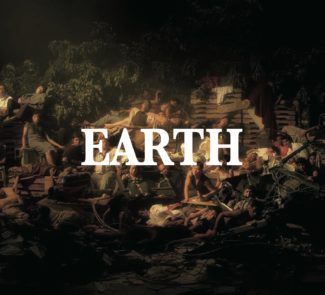
Commissioned for the Engawa – Japanese Contemporary Art Season programme organized by Calouste Gulbenkian Museum's Modern Art Center, The Voice of Inconstant Savage is an immersive installation that superimposes a prayer inspired by the story of a 16th-century Portuguese missionary, a chant from a Kakure-Kirishitan (hidden Christians) prayer – a religion rooted in Nagasaki Prefecture –, a chant from the Karawara spirits of the Awá indigenous people – who live in the Amazon rainforest – and a chorus of Western Gregorian chant. Morinaga questions the position of the aesthetics of inconstancy in relation to the discourse of the “savage” that modern society confronts.

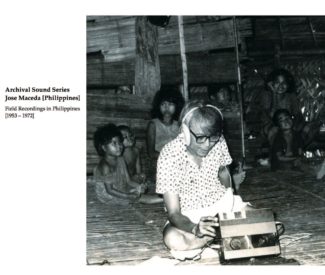
Field recordings

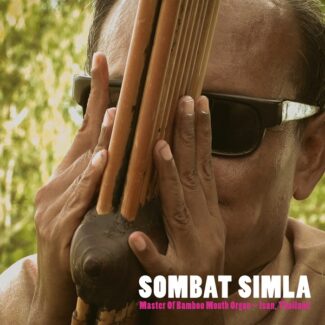
Sombat Simla: Master Of Bamboo Mouth Organ
Simla is known in Thailand as one of the greatest living players of the khene, the ancient bamboo mouth organ particularly associated with Laos but found throughout East and Southeast Asia. His virtuosic and endlessly inventive renditions of traditional and popular songs have earned him the title ‘the god of khene’, and he is known for his innovative techniques and ability to mimic other instruments and non-musical sound, including, as a writer for the Bangkok Post describes, ‘the sound of a train journey, complete with traffic crossings and the call of barbecue chicken vendors’.

Performing arts

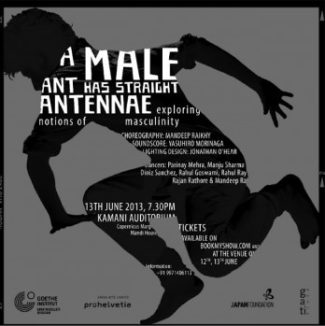
TEOAS
On 22 June 2017, the 16-year-old Junaid Khan was stabbed to death on a Mathura-bound train by a mob that allegedly mocked his skullcap and called him a beef-eater. Responding to the growing number of cases of mob lynching triggered by hate-driven communal politics in India, this work studies the actions that constitute prayer. In examining four movements — bowing, kneeling, lowering the forehead to the floor, and bringing one's palms together — 'the extremities of a surface are lines' poses questions of deference and resistance. How does the body perform its beliefs? What is the physicality of deference? What notions of space and time are embedded in the act of praying? Can deference, when performed outside its usual contexts, and repeated ceaselessly, transform into an act of resistance? How do shape, topography, orientation and horizontality inform our understanding as performers of belief? The soundscape features Junaid’s mother Saira’s testimony about her son’s death, looped and transformed into a haunting call against hate and oppression. In doing so, it references the politics of Steve Reich's 'Come Out' (1966), which loops four seconds of testimony from a wrongfully detained man in Harlem, as a potent reminder of the injustices the civil rights movement sought to address. This work stemmed out of engagements with the #NotInMyName campaign. It was briefly titled Bodies of Dissent and then presented as a work-in-progress with the title 'Pray' as part of 'Long Nights of Resistance'. The work was subsequently called 'Geometries of Faith', and then 'Geometries of Belief'. It is now titled 'the extremities of a surface are lines', in resonance with the Euclidean sense of geometry its choreographic treatment has invoked. The changing titles have had much to do with the subject of faith and belief. They cannot be defined with absolute conviction and can only ever be performed as an embodied proposition, subject to the conditions of a given time and space.

Event/Workshop

RECIPROCAL RESIDENCIES
Reciprocal Residencies: Lijiang/Hokkaido consists of two reciprocating residencies between two Japanese and three Chinese artists in two rural settings. Curated by Jay Brown and Yasuhiro Morinaga, the residency is developing working methods to make the most of our disciplinary differences and time together. The participants are: Yao Chunyang, Wei Wei (aka VAVABOND), Li Jianhong, Marina Tanaka, Chiharu MK, Yasuhiro Morinaga, Jay Brown, Lijiang Studio, Tobiu Art Camp. This project enjoys the support of the Beijing Contemporary Art Foundation and the Asian Cultural Council. What does it take to make art while being responsible for small children? To that end, we titled our September 14th performance at Tobiu Art Festival “Art With/Out Small Children”, and it seems this will become the title for the Hokkaido segment of the project. Another, similar, working title for the project that may become the title for the Lijiang segment is “We Are All Great Parents.” We are foregrounding this issue because of the social, systemic, logistical obstacles for artists, nearly always mothers, to continue developing and presenting their art while raising small children (not to mention working a day job). Nearly all the artists in the project are in the middle of such challenges. Furthermore, we all have long-term interest in exploring ways of working “in the field”. Each of us has 10, 15, or more years of developing their own experiences with this question, an engagement which has formed our understanding of artistic research. What could each of us do in a totally unfamiliar place? How do we deal with certain inescapable dynamics, such as countenancing a history of cultural erasure, tourist development, the cosmologies of others, or the ontologies of places? There will be more to come on this project, but for now some snapshots of our time in Hokkaido:

Performing arts

GONG ex MACHINA
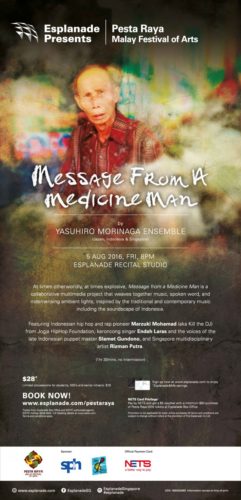
A sonic theatre "Gong ex Machina" is created based on the sound composition. The event will also highlight and develop the presence of sounds as its anchor. “Gong ex Machina”, is a word play from a technical term in ancient Greece in the 5th century: Deus ex Machina, which more or less means God in or out of the machine. The term refers to the technique to present actors playing as gods on the stage of a Greek tragedy using equipment like cranes, moving up and down, or a trap door, to allow the actor coming from below the stage. Hence, Gong ex Machina, a gong in or out of the machine. The concept of the performance evolves from a reflection following an extensive research by Morinaga on the gong culture throughout South East Asian countries. Gong ex Machina also stems from the history of an encounter between music or sound cultures and the modern technology of sound recorder and player: phonograph or gramophone. Similar to other encounters between tradition and modernity—happened against the background of the industrial revolution and European colonialism in the 17th to 20th century—the encounter of gong culture with gramophone is a story of a complicated acquaintance. Apart from stories of adaptation and appropriation are also stories of distortion and manipulation. It was an encounter that changed the way we experience and understand music, in particular, or sounds in general.