Installation

Autoethnography – HAMAKAI
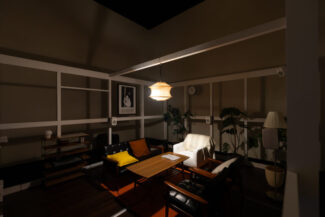
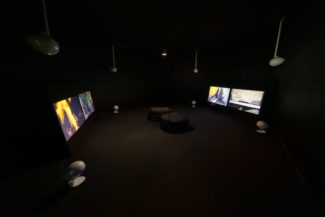
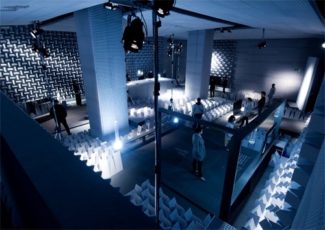
This work is an immersive sound installation that employs spatial audio technology. “Hamakai” refers to a form of vocal communication practiced by the Awa people—said to be the last nomadic hunter-gatherers in the Amazon—who mimic the calls of their prey while hunting in the forest. In recent years, the artist has traveled to the region multiple times to conduct fieldwork and record Hamakai. At the same time, the artist also recorded the sounds of illegal logging facing the Awa people, as well as the sounds of the railway laid in the vicinity to transport raw materials for steel production. This work captures the diverse sounds that coexist in the Awa people’s current living environment. Furthermore, this work is structured to offer an objective perspective on the artist herself as she conducts participant observation using a cultural anthropological approach. Throughout the piece, the focus is on a conversation between a father and his daughter in their living room—a reference to Gregory Bateson’s dialogic expression technique known as “metalogue.” The father joyfully shares the insights he gained during his fieldwork, while the daughter learns about this unknown world. At the end of the conversation, the daughter raises a fundamental question about the practice of participant observation itself. Preserving the cultures of others, conducting research using scientific methods, and addressing the pressing issue of environmental and cultural extinction… Through theatrical techniques, these multifaceted elements are expressed within the soundscape. Photo: TOMITA Ryohei Photo Courtesy: NTT InterCommunication Center [ICC]
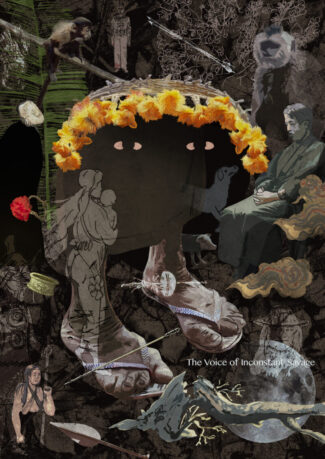
The Voice of Inconstant Savage

Commissioned for the Engawa – Japanese Contemporary Art Season programme organized by Calouste Gulbenkian Museum's Modern Art Center, The Voice of Inconstant Savage is an immersive installation that superimposes a prayer inspired by the story of a 16th-century Portuguese missionary, a chant from a Kakure-Kirishitan (hidden Christians) prayer – a religion rooted in Nagasaki Prefecture –, a chant from the Karawara spirits of the Awá indigenous people – who live in the Amazon rainforest – and a chorus of Western Gregorian chant. Morinaga questions the position of the aesthetics of inconstancy in relation to the discourse of the “savage” that modern society confronts.

POLLINATORS

Focusing on the life of the Hmong people who live in the mountainous regions of northern Vietnam, on this occasion Morinaga presents an installation that overlays shamanistic rituals to wade off evil and misfortune with the honey-collecting activities of beekeepers. Through the symbiotic coexistence of humans, the environment, and life brought about by the respective dialogue between the shaman/spirits and beekeeper/bees, the work serves to introduce an alternative perspective to our social life and the coded systems that exist within it.

CDOSA

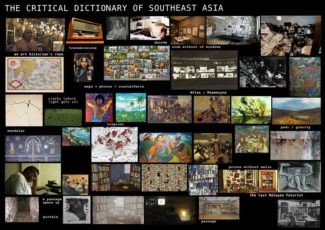
CDOSA (the critical dictionary of southeast asia), begins with a question: what constitutes the unity of southeast asia — a region never unified by language, religion or political power? cdosea proceeds by proposing 26 terms — one for each letter of the english / latin alphabet. each term is a concept, a motif, or a biography, and together they are threads weaving together a torn and tattered tapestry of southeast asia. cdosea is a platform facilitating ongoing research, a matrix for generating future projects and an oracular montage machine.

Trading Garden

未来のモビリティに乗って過去へサウンドスリップ

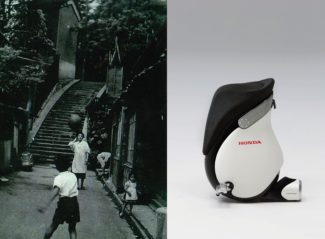
ヘッドセットをしてホンダのユニカブに乗ると、アークヒルズが昭和の頃のかつての「麻布谷町」へとタイムスリップ。かつての六本木界隈を忍ばせる昭和の生活空間のサウンド、金魚売りや豆腐売りやチンドン屋の声を、実際の外音と共存させながら聴くことで、都市における聴覚文化を考える音のAR作品「Trading Garden 市場の庭」

Sony at Milano Salone

ソニーが提案するホームプロダクツの新たなデザインコンセプト、モノリシックデザインを核に、その世界観を発展させて生まれたアーキタイプ(原型)をミラノ国際家具見本市、ミラノサローネで展示します。シンプルで美しいデザインを訴求したモノリシックデザインの根底にある「物事の本質を追求する」というコンセプトは、空間における製品の佇まいだけでなく、生活空間におけるホームエンタテインメントのあり方をも変えていく可能性を秘めています。「光」「音」「映像」を融合させて生まれた実験的な展示を通じて、生活空間における新たな可能性を提案します。