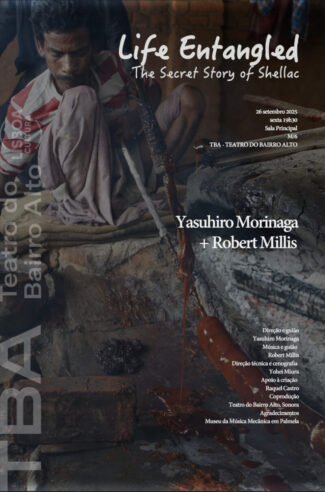
Installation

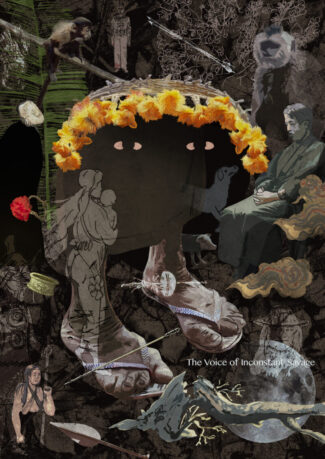
The Voice of Inconstant Savage
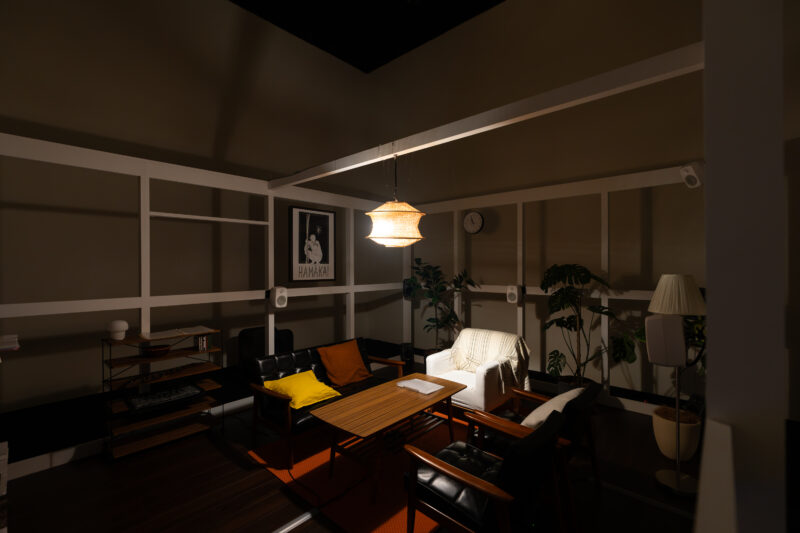
Commissioned for the Engawa – Japanese Contemporary Art Season programme organized by Calouste Gulbenkian Museum's Modern Art Center, The Voice of Inconstant Savage is an immersive installation that superimposes a prayer inspired by the story of a 16th-century Portuguese missionary, a chant from a Kakure-Kirishitan (hidden Christians) prayer – a religion rooted in Nagasaki Prefecture –, a chant from the Karawara spirits of the Awá indigenous people – who live in the Amazon rainforest – and a chorus of Western Gregorian chant. Morinaga questions the position of the aesthetics of inconstancy in relation to the discourse of the “savage” that modern society confronts.

Field recordings

Sombat Simla: Master Of Bamboo Mouth Organ
Simla is known in Thailand as one of the greatest living players of the khene, the ancient bamboo mouth organ particularly associated with Laos but found throughout East and Southeast Asia. His virtuosic and endlessly inventive renditions of traditional and popular songs have earned him the title ‘the god of khene’, and he is known for his innovative techniques and ability to mimic other instruments and non-musical sound, including, as a writer for the Bangkok Post describes, ‘the sound of a train journey, complete with traffic crossings and the call of barbecue chicken vendors’.

Cinema

The Mental Traveller
The Mental Traveller is a poetic reflection on the nature of remembrance. It navigates through the mental spaces of people consumed by memories of lost time.The film meditates on the passing of time, external behaviors, habitual patterns of thought and the sensorial realities of five mentally disordered men inside the psychiatric ward in Chanthaburi Province, east of Thailand, in which it is filmed. The film was conceived from the director’s connections to his parents and companions as they went through states of sickness, impending death, dementia, grief, and temporary insanity. At the same time it echoes upon the turbulent years of political upheavals and repercussions in Thailand, resulting the nation in a state of delirium, lunacy and trauma.

Field recordings

Gong Culture of Southeast Asia「Co-Ho」
コホ族はモン・クメール語系に属しており、ベトナム中部高原地帯の南部に居住しています。本作はベトナムのラムドン省にある二つの集落で収録したゴング音楽になります。コホ族はアニミズムを信仰しており、生活におけるあらゆるものが神霊(Yang)と悪霊(Cha)に分けられるといい、音楽と儀礼が密接に関係している民族だといえます。今回、録音するために訪問したある家では、ゴングを演奏する際に神霊(先祖)に演奏の許しをもらうための儀式を行なっていました。この儀式では、酒壺の中に入った木屑を部屋のあちこちの壁にくっつけ、演奏者たちが神霊(先祖)に祈りを告げていくというものでした。この儀式の後に、2つのゴングを交互に演奏していく即興によるゴング音楽(トラック1)は素晴らしく貴重な録音だったといえます。また、彼らが演奏するゴングの数は2つ、3つ、4つ、5つ、6つと多岐にわたっており、インターロッキングによる奏法を使った見事な演奏でした。今回レコーディングさせていただいたコホ族のある民家では、頻繁に演奏者同士が集まって練習すると言っていましたが、もう一つのゴングの演奏グループは、新メンバーが加わり、練習時間もろくになかったために満足いく演奏ができたのは数曲だけだったと残念がっていました。その数曲がトラック6と7になります。

Outland ethnologies

HOKKAIDO WITH & LIJIANG WITH/OUT
The experiments presented here, Hokkaido With and Lijiang With/Out are, if you will believe it, connected. Think of them as an evolution of inquiries into an artist’s presence or absence in an unfamiliar place, built on both doubt and confidence, both a lack and a surfeit of context. Both projects put pressure on artists by putting them in difficult situations, but by working directly with these problems, the projects and the artists open up new possibilities in their unusual approaches.